
Thursday, August 12, 2021

Sunday, July 18, 2021
Our Students Are Gassy
Could we go back into our dojo at this time? Technically, yes. So why haven’t we? It seems our students are very gassy. Huh?
Gas molecules spread to fill out whatever size container they’re in. When we have 8 students in the double classroom (800 sq ft), they stand far apart and fill the space. When these same 8 students are in the buffet room (1,200 sq ft), they stand farther apart, filling that space. When we go outside on the patio (a few thousand sq ft), students stand faaar apart, trying to fill the vast space. What’ll happen when we go back into a 350 sq ft dojo?
After 9/11/2001, all flights were grounded nationwide. Once flying resumed, people were startled whenever they heard a low-flying plane. This lasted for a while until ‘normal’ became routine again. I understand everyone’s concern. Masks, social distancing, and non-contact have us gun shy. It’ll take a while before we feel ‘normal’.
Once we go back into the dojo we’ll try to keep minimum 6 foot social distance. In order to do so, we’ll need to restrict how many students come to each class to avoid overcrowding. So far, our gassy students don’t seem ready for this close distance. So when will we go back to the dojo on a regular basis? Soon… soon.
Gas molecules spread to fill out whatever size container they’re in. When we have 8 students in the double classroom (800 sq ft), they stand far apart and fill the space. When these same 8 students are in the buffet room (1,200 sq ft), they stand farther apart, filling that space. When we go outside on the patio (a few thousand sq ft), students stand faaar apart, trying to fill the vast space. What’ll happen when we go back into a 350 sq ft dojo?
After 9/11/2001, all flights were grounded nationwide. Once flying resumed, people were startled whenever they heard a low-flying plane. This lasted for a while until ‘normal’ became routine again. I understand everyone’s concern. Masks, social distancing, and non-contact have us gun shy. It’ll take a while before we feel ‘normal’.
Once we go back into the dojo we’ll try to keep minimum 6 foot social distance. In order to do so, we’ll need to restrict how many students come to each class to avoid overcrowding. So far, our gassy students don’t seem ready for this close distance. So when will we go back to the dojo on a regular basis? Soon… soon.
Saturday, June 26, 2021
Renshu (練習) vs Keiko (稽古)
Here are two similar Japanese terms: RENSHU and KEIKO.
- RENSHU (練習) is to practice on your own, rote repetition, polish your technique.
- KEIKO (稽古) is a lesson in class under the sensei’s guidance. Keiko implies study for a deeper understanding of your technique. It often involves hands-on training, working bunkai (analysis; disassembly; examination) of fighting techniques found within your kata.
We have been unable do to hands-on training during COVID. No kumite… no ippons… mostly basics and kata, and for change of pace, kata and basics. We have grabbed sticks to simulate arms and legs. We have discussed how a move works. As someone once said: It’s like trying to fill your hunger by reading a menu. You get it in theory, but it’s not really satisfying.
On the positive side, we polished our basics, learned new kata, and honed our techniques. Now that pandemic restrictions are lifting, we can take these new, improved techniques and start applying them on each other in more realistic scenarios.
Our restricted training and Zoom effectively served a limited purpose. It kept us from rusting or forgetting our Karate. The best news is that better days are ahead. To be ready, to stay ready, follow what I usually shout out at the end of class: PRACTICE!
- RENSHU (練習) is to practice on your own, rote repetition, polish your technique.
- KEIKO (稽古) is a lesson in class under the sensei’s guidance. Keiko implies study for a deeper understanding of your technique. It often involves hands-on training, working bunkai (analysis; disassembly; examination) of fighting techniques found within your kata.
We have been unable do to hands-on training during COVID. No kumite… no ippons… mostly basics and kata, and for change of pace, kata and basics. We have grabbed sticks to simulate arms and legs. We have discussed how a move works. As someone once said: It’s like trying to fill your hunger by reading a menu. You get it in theory, but it’s not really satisfying.
On the positive side, we polished our basics, learned new kata, and honed our techniques. Now that pandemic restrictions are lifting, we can take these new, improved techniques and start applying them on each other in more realistic scenarios.
Our restricted training and Zoom effectively served a limited purpose. It kept us from rusting or forgetting our Karate. The best news is that better days are ahead. To be ready, to stay ready, follow what I usually shout out at the end of class: PRACTICE!
Friday, June 11, 2021
The Herbert Rule

One day we were working the three Tekki katas and one of the Brown Belts posed this question: Why does yame in Tekki Sho step in halfway with the right foot as your hands come out, step in the rest of the way with the left foot as your hands come together, and step out with the left foot to finish yame. Then Tekki Ni yame steps in halfway with the left foot, the rest of the way in with the right foot, then out with the left foot to finish yame. Then Tekki San ends like Tekki Sho – in halfway right, in left, out left. Hmmm… good question.
Other schools may yoi and yame different from us, but we have always been consistent since at least 1972. We yoi stepping in with the left foot, and then out with the left foot. Yame, with rare exception, ends the same way, stepping in and out with the left foot. A notable exception is Heian Sandan. The last stance being a wide kibba dachi, we step in halfway with the right leg, then do a regular left-left yame. Back to the question posed: All three Tekki katas end in kibba dachi, so it makes sense to step in halfway before doing a standard yame. Why is Tekki Ni different from the other two? I dunno… to be different? Maybe to keep you alert?
That’s when young Herbert piped up: It’s determined by the final kata attack. Whutchu talkin’ ‘bout Herbert? He then proceeded to show how all katas through San Kyu yame with the leg on the attacking side. Aha! But what about Heian Sandan? You throw a left punch, but yame with the right leg, so there! Herbert said it’s a left hook punch over the right shoulder, making it a right side attack, so yame starts with the right leg. The kid had an idea, held his ground, and proved his premise correct. This may not be the reason for yame, but it’s a great way to remind you which leg moves in for yame. Since that day, I refer to this idea as the ‘Herbert rule’.
Monday, May 31, 2021
The Very Definition of 'Osu!' 押忍!
A couple of days ago a very high ranking, important Black Belt in Japan posted a video on Facebook showing his students’ fine performances at a Tokyo tournament. They did extremely well, but barely missed taking runner-up. He lamented that this was because of lack of practice due to COVID shutdowns. He further commented that he, too, could not practice as he wanted. He is a national tournament champion, and feels that his inability to train as he did previously has exacerbated his back pains. It is upsetting to not work his kata more than a few times before the pain becomes intense.
The last thing this wonderful Karate master needs is advice from lowly little me, but that didn’t stop me from commenting on his post. I thanked him for posting the video of his students’ excellent competition. I then brashly added the following:
 We knew an American competitor, Jim Smith. If he did not make at least runner-up he would say, “The answers are back in the dojo”. This is difficult when pandemic has closed your dojo. Stay strong, COVID will end soon.
I, too, have back pain (and knees, and hips, and shoulder). Keep a strong positive attitude; it does help. I believe the correct phrase for pushing forward against great adversity is: Osu! 押忍!
We knew an American competitor, Jim Smith. If he did not make at least runner-up he would say, “The answers are back in the dojo”. This is difficult when pandemic has closed your dojo. Stay strong, COVID will end soon.
I, too, have back pain (and knees, and hips, and shoulder). Keep a strong positive attitude; it does help. I believe the correct phrase for pushing forward against great adversity is: Osu! 押忍!
The last thing this wonderful Karate master needs is advice from lowly little me, but that didn’t stop me from commenting on his post. I thanked him for posting the video of his students’ excellent competition. I then brashly added the following:

Thursday, May 13, 2021
Why Can't I Test?

One brown belt student asked me if he could test. I said ‘no’ for several reasons, one is he already had a COVID promotion. Once a student reaches 4th Kyu purple belt, they have a minimum wait requirement and must be invited to test. As my Sensei often said, if you ask permission to test, you show you are not ready. Many intangibles are taken into account, not just the physical ability to perform new kata. The student must show mental readiness, which includes the patience to be invited to test.
The biggest reason this student was told ‘not yet’ is because he still hasn’t learned his fact sheet given out to all white belts, told to learn, and quizzed on at each rank examination. This consists of one page of history and Japanese terminology we use every day in class. “What’s the big deal? I know my new kata, and I know how to fight.” He may know the sequence of the kata, but has very limited understanding of the techniques. “What good is learning the fact sheet? I ain’t never gonna need it.” We train more than the body, also the mind and spirit. Learning the fact sheet takes some discipline and dedication – two important traits for higher ranks. As a brown belt, he should set an example for other students. If a yellow belt asks him for help on a history or terminology question, it looks bad if he says “I don’t gotta know that stuff.” When the class is going through basics, it looks bad when he has to watch what others do because he doesn’t know his Japanese commands, or worse, slow us down as I must say and demonstrate the term he should already know.
Did I mention this brown belt is an adult in his 40s, a college graduate, and successful business owner? I put it in collegiate terms he should understand. To get his degree in business, he was required to take liberal arts courses. Were they useless, or did they help him by rounding out his thought process, helping him think faster on his feet? If he wanted just business classes, there are schools that offer certificate programs. If he wanted the degree, he was required to pass all the non-business courses as well. If he wants to just learn fighting, he could enroll in boxing, or MMA, or jiu jitsu. (And don’t yell at me how those arts are mental as well as physical. I know that, but try to convince my brown belt of that) You want rank in a traditional Karate dojo? Meet all the traditional requirements of that dojo.
A higher ranking student should never ‘ask’ to test. His technique, knowledge, and attitude should necessitate his being told to test. “So, can I test yet? Pleeeze!!!” No, not yet.
Saturday, April 17, 2021
Adjust - Adapt - Apply

We are still out of our dojo thanks to COVID. Fortunately, there are other areas available within the Temple that hosts our dojo. We sometimes use an 800 sq ft double classroom, or the 1,200 sq ft buffet room, or outdoors on the patio. These are harder surfaces than our padded deck, making turns, pivots, kicks, stomps, etc more punishing on our feet. We wear shoes or sneakers, but even that affects our kata, timing, rhythm, and general movement.
Moving and pivoting on various floor surfaces can take a toll. Some members feel it in their feet, or ankles, or knees, or back. A few members felt achy side effects from COVID vaccines. We all learn to adjust our techniques, adapt to our difficulties, and apply our Karate to the best of our ability. That shows great attitude and spirit. Ganbatte! Osu!
Thursday, March 18, 2021
One Year of COVID

Less obvious, but more important has been the effect on our individual members. Self-quarantine, lockdown, work from home, remote schooling, business closings, social distancing, etc have all taken toll on our ’normal’ way of life. Many people are out of shape and gained weight due to their sudden sedentary lifestyle. Too many elements are out of our control. Life as we know it is completely disrupted. Continued training during these pandemic times offers members a sense of normalcy. Our class schedule allows members to have some structured regularity to their week. Working out releases endorphins, allowing you to feel better and counter the effects of depression and stress.
This pandemic reinforces my longstanding beliefs in Karate training: Karate is a microcosm of life. Everything that goes on in the dojo also occurs in the real world. There are some katas you like better than others, and some techniques you absolutely hate. You must learn to perform everything at least passably to improve and move up in rank. In life, you have fellow students or coworkers you like better than others, you may have teachers or bosses that you dislike, but you must learn to get along with them and perform your tasks satisfactorily. Keeping routine of going to the dojo and the structure of class can help you organize your life for better efficiency.
Hopefully, we will go back inside the dojo and return to physical contact in the near future. In the meantime, DŌ GAKUIN will continue to offer our members a sense of normalcy in these crazy times. See you for training - wherever that may be!
Thursday, March 4, 2021
'Footloose' Footwork
We worked on footwork last week in class. It reminded me of something back in 2014 when I attended a weekend of seminars with Okano-kancho in Perry, FL. Among the workouts, he wanted to lead us through some footwork drills, commenting that he uses a ladder on the ground for these exercises. I knew his father, Okano-soke, had some extreme training measures. Since I did not use exercise ladders or was exposed to them, I thought he meant an actual wooden or aluminum ladder on the floor, with 4 inch side rails and thick rungs, which could do tremendous damage if you misstep.
 Anyway, Kancho had us work a step-over drill moving up and down the mats. I used to cover Saturday Judo classes in the 1980s for my buddy Jimmy Zoubantes. I would lead his class through the same drill Kancho had us do, and others even more complex. I guess my muscle memory was still there, as I flew up and down the mats. Well, ‘flew’ for a then-60 year old man, but I moved much faster than many participants much younger than me.
It was after the seminars that I learned about agility ladders: nylon struts with thin plastic rungs that lay flat to the ground. Oh, so there’s really nothing to trip over or harm you if you step out of bounds? You’re playing hopscotch.
Then I related it to kata. There are martial artists who don’t like kata. It’s useless; they’d never use a kata move in a fight; it’s a waste of their time. They’d use a basic punch, kick, or simple combination. They’re right – and wrong. They don’t understand what kata is all about. Basics do come out automatically because we practice them so often. Kata builds muscle memory on moves and combinations not normally used every day. Kata practice allows you to employ a technique in kumite or actual self-defense, should the situation present itself.
My Judo footwork drills from the 1980s kicked in muscle memory 30 years later. We’ve had former students return after many years’ absence and regain their former skills rapidly due to muscle memory. Work the process. Trust the process. The process works!

It was after the seminars that I learned about agility ladders: nylon struts with thin plastic rungs that lay flat to the ground. Oh, so there’s really nothing to trip over or harm you if you step out of bounds? You’re playing hopscotch.

Then I related it to kata. There are martial artists who don’t like kata. It’s useless; they’d never use a kata move in a fight; it’s a waste of their time. They’d use a basic punch, kick, or simple combination. They’re right – and wrong. They don’t understand what kata is all about. Basics do come out automatically because we practice them so often. Kata builds muscle memory on moves and combinations not normally used every day. Kata practice allows you to employ a technique in kumite or actual self-defense, should the situation present itself.
My Judo footwork drills from the 1980s kicked in muscle memory 30 years later. We’ve had former students return after many years’ absence and regain their former skills rapidly due to muscle memory. Work the process. Trust the process. The process works!
Monday, January 18, 2021
Martin Luther King Day - Your Life's Blueprint

The quote above was meant for civil rights, but it also applies to civics today. Instead of causing havoc, rioting, and looting, we’re better served by working on ways to improve our lives – as Americans and as private citizens.
It also applies to Karate training during these COVID times. So if you can’t fly, then run… walk… crawl to keep moving forward. We’re not back in the dojo yet, but come work out with us at the Temple, or on Zoom, but keep moving forward.
Thursday, January 14, 2021
If your stance is weak, your Karate is weak
A few days ago I posted about weight distribution in stances. This Facebook memory came up on my timeline today:
 As far back as 1979 I would go upstate NY to attend Hidy Ochiai's annual invitational tournament. At the Black Belt meeting before the event, he would talk about how he judges from he ground up. He would say that the strongest punch thrown from a weak, wobbly stance is a weak, wobbly punch. *food for thought*

Monday, January 11, 2021
Weight Distribution
def: SHINSA
Examination; judging; inspection; investigation.
We held Shinsa (rank examination) yesterday. One student had difficulties with back stances (I understand… COVID times… we’re not in the dojo… we’re on concrete floors… we’re wearing sneakers… yada yada yada), so I asked him what his weight distribution should be. He said 60%-40%. I routinely tell students 75-25 (we’ll discuss this later), so I then asked two Brown Belts what they thought. One said 70-30 and the other said 80-15 (?!). Many different instructors in many different dojos have many different answers. Nobody will put you on scales to see exactly what the weight distribution is, but percentages give you a guide as to how stance works.
Front stance (zenkutsu dachi): I’ve heard 60-70-80% weight on the front leg because your weight/force is going forward. We recognize that the back leg drives the body forward as much as the front leg steps forward. We therefore say the weight distribution is 50-50.
Back stance (kokutsu dachi): Body weight is shifted to the back leg with the feet in straight line. This means your front leg could be swept. With most of the weight on the rear leg you can shift all the weight back to avoid the sweep or kick with the front leg. We use a number halfway between 100%-0% and a 50%-50% shift to front stance. Mathematically, that would be 75%-25%.
Horse stance (kiba dachi) and immovable stance (fudo dachi): Pretty basic, the balance is 50-50 on each leg.
Cat stance (neko ashi dachi): Where back stance is two shoulders length, cat stance is roughly halfway back at around one shoulder length. We say the weight distribution is 85-15.
Hourglass stance (sanchin dachi): Your front heel just about touches your rear ankle. There is almost no weight on the front leg, so we say 95-5.
Crane stance (sagi ashi dachi): One leg is completely off the ground, with the foot touching the standing leg. Weight distribution is obviously 100-0.
Cross legged stance (kosa dachi): We used to look at kosa dachi as unstable, impractical, and not very mobile. We learned from kobudo training with Oshiro-shihan that the stance is highly mobile moving forward and back, as well as side to side. Each foot is turned out 45 degrees, one behind the other, the rear shin resting on the front calf. Most weight is on the front leg, hips drive the body forward, and the rear leg props up the stance. It is surprisingly stable as you are ‘sitting’ on your front leg with the rear leg supporting the stance at 80-20.
We understand that stance is transitional. You do not fight strictly out of front stance, back stance, etc. You should move fluidly, shifting the body, to fit the situation and your strategy. Proper stance strengthens your legs, teaches you to stabilize your body, while upsetting your opponent's balance.
We held Shinsa (rank examination) yesterday. One student had difficulties with back stances (I understand… COVID times… we’re not in the dojo… we’re on concrete floors… we’re wearing sneakers… yada yada yada), so I asked him what his weight distribution should be. He said 60%-40%. I routinely tell students 75-25 (we’ll discuss this later), so I then asked two Brown Belts what they thought. One said 70-30 and the other said 80-15 (?!). Many different instructors in many different dojos have many different answers. Nobody will put you on scales to see exactly what the weight distribution is, but percentages give you a guide as to how stance works.
Front stance (zenkutsu dachi): I’ve heard 60-70-80% weight on the front leg because your weight/force is going forward. We recognize that the back leg drives the body forward as much as the front leg steps forward. We therefore say the weight distribution is 50-50.
Back stance (kokutsu dachi): Body weight is shifted to the back leg with the feet in straight line. This means your front leg could be swept. With most of the weight on the rear leg you can shift all the weight back to avoid the sweep or kick with the front leg. We use a number halfway between 100%-0% and a 50%-50% shift to front stance. Mathematically, that would be 75%-25%.
Horse stance (kiba dachi) and immovable stance (fudo dachi): Pretty basic, the balance is 50-50 on each leg.
Cat stance (neko ashi dachi): Where back stance is two shoulders length, cat stance is roughly halfway back at around one shoulder length. We say the weight distribution is 85-15.
Hourglass stance (sanchin dachi): Your front heel just about touches your rear ankle. There is almost no weight on the front leg, so we say 95-5.
Crane stance (sagi ashi dachi): One leg is completely off the ground, with the foot touching the standing leg. Weight distribution is obviously 100-0.
Cross legged stance (kosa dachi): We used to look at kosa dachi as unstable, impractical, and not very mobile. We learned from kobudo training with Oshiro-shihan that the stance is highly mobile moving forward and back, as well as side to side. Each foot is turned out 45 degrees, one behind the other, the rear shin resting on the front calf. Most weight is on the front leg, hips drive the body forward, and the rear leg props up the stance. It is surprisingly stable as you are ‘sitting’ on your front leg with the rear leg supporting the stance at 80-20.
We understand that stance is transitional. You do not fight strictly out of front stance, back stance, etc. You should move fluidly, shifting the body, to fit the situation and your strategy. Proper stance strengthens your legs, teaches you to stabilize your body, while upsetting your opponent's balance.
Wednesday, December 30, 2020
Sean falls down

I did a final one-on-one Zoom session with Sean yesterday. He was in his bedroom, wearing street clothes (including socks), and practicing Tekki Sho. His stance was a little wide, and his feet slipped out from under him. One moment I saw him, and the next moment he disappeared below camera view. He climbed right back up and commented that his socks caused him to slip. I said he slipped because his stance was too wide. He didn’t believe me, so I put on a pair of socks and demonstrated Tekki Sho without loss of balance. I then explained the following to him:
There is a difference between low stance and deep stance. Young, agile, athletic martial artists should be in a low stance. This lowers their center of gravity, stabilizing them, and knocking their opponent off balance. Older martial artists learn to deepen their stance by dropping their hips. They may not be as low as the young, but should be just as solid in stance. Most people can appear lower by leaning forward or spreading their legs too long/wide. Yes they appear low, but they’re unsteady.

I'll often ask students what is the root word for 'stance'. The answer is 'stand'. I'll then tell them, in Karate, the proper way to stand is to drop your butt and sit down!
Tuesday, December 29, 2020
Clean, crisp techniques
A few of our students entered online tournaments the past few months. While I applaud their efforts and commend them for competing in these difficult COVID times, I couldn’t say I was impressed by their performances. Not trying to be mean or overly judgmental, but simply recognizing that they performed better in the past.
Then I thought about it – We haven’t been in the dojo since March 16th. We’ve been working out in street clothes, wearing shoes, outside on concrete or indoors on carpeting, marble floors, or wood floors. Balance, shifting, and footwork is not the same. We cannot spar or work ippons. Almost all of our techniques have suffered, so why bother? We’ve essentially been treading water, waiting for social distancing restrictions to lift and we get back to regular training. Once we’re back to “normal” we shouldn’t be too far out of practice.
I then watched the other competitors’ videos. They did not particularly impress me either. Worldwide, techniques have suffered. While talking to other martial artists, two particular words kept coming up: Clean and Crisp. A non-martial arts friend asked me to describe clean and crisp. I had difficulty putting the ideas into words; I just know it when I see it.
I admire our students for training and progressing slowly (or at least not falling behind). It gives me hope that we will improve rapidly with clean, crisp movements once normalcy returns.
Then I thought about it – We haven’t been in the dojo since March 16th. We’ve been working out in street clothes, wearing shoes, outside on concrete or indoors on carpeting, marble floors, or wood floors. Balance, shifting, and footwork is not the same. We cannot spar or work ippons. Almost all of our techniques have suffered, so why bother? We’ve essentially been treading water, waiting for social distancing restrictions to lift and we get back to regular training. Once we’re back to “normal” we shouldn’t be too far out of practice.
I then watched the other competitors’ videos. They did not particularly impress me either. Worldwide, techniques have suffered. While talking to other martial artists, two particular words kept coming up: Clean and Crisp. A non-martial arts friend asked me to describe clean and crisp. I had difficulty putting the ideas into words; I just know it when I see it.
I admire our students for training and progressing slowly (or at least not falling behind). It gives me hope that we will improve rapidly with clean, crisp movements once normalcy returns.
Friday, November 13, 2020
Second wave of COVID?
OK, so now ‘the powers that be’ are saying that another round of lockdown and shelter in place takes effect todday at 7pm. This may mean that restaurants, bars, and gyms once again face severe restrictions or possibly even close down.
Don’t get me wrong, I’m all for safety and doing whatever is necessary to defeat COVID, but this makes no sense. Einstein is attributed to saying: “Insanity is doing the same thing over and over and expecting different results.” The first round of ‘lockdown and shelter in place’ did not work. It did however, cripple businesses, psychologically paralyze many people, and wreak havoc with the economy. Oh sure, blame the solution. There is no immediate solution. Measures currently in place were supposed to ‘flatten the curve’ in 14 days. We’re now into the 8th month. A big problem is that too many people refuse to follow COVID guidelines. Crack down on violators. Don’t just fine event venues for holding unsafe events, cite the attendees. Venues cannot completely control what attendees do every moment they’re on premises. Hit people in their wallets with fines and they’re more likely to follow guidelines and avoid venues not in compliance. Nobody attending, and violating venues will change or close.
Essential workers and essential businesses are allowed to operate as normal. What is an ‘essential worker’? Health professionals? Sure. Grocery store workers? Questionable. The grocery stockboy is now an ‘essential worker’ while still earning minimum wage. Let’s all stand outside our homes at 7pm and bang pots together to honor essential workers. Hmmm… Nice thought, but meaningless.
So why are we facing another round of ‘lockdown and shelter in place’? We’re relying on our previous experience with COVID. Wait a minute - we have no previous experience with COVID. Officials are basically flying by the seat of their pants. COVID testing shows how the virus is on the rise. Wait a minute - we have no previous experience with COVID testing. November is cold and flu season. The common cold, flu, and even pneumonia are viral. Coronavirus is a virus, too. Who knows how much COVID these tests are detecting, and how much is false positive caused by other winter viruses?
I have no say over lockdowns and stay at home orders. OK, bring it on. Let’s see what breaks first, COVID, the economy, or our sanity.
Don’t get me wrong, I’m all for safety and doing whatever is necessary to defeat COVID, but this makes no sense. Einstein is attributed to saying: “Insanity is doing the same thing over and over and expecting different results.” The first round of ‘lockdown and shelter in place’ did not work. It did however, cripple businesses, psychologically paralyze many people, and wreak havoc with the economy. Oh sure, blame the solution. There is no immediate solution. Measures currently in place were supposed to ‘flatten the curve’ in 14 days. We’re now into the 8th month. A big problem is that too many people refuse to follow COVID guidelines. Crack down on violators. Don’t just fine event venues for holding unsafe events, cite the attendees. Venues cannot completely control what attendees do every moment they’re on premises. Hit people in their wallets with fines and they’re more likely to follow guidelines and avoid venues not in compliance. Nobody attending, and violating venues will change or close.
Essential workers and essential businesses are allowed to operate as normal. What is an ‘essential worker’? Health professionals? Sure. Grocery store workers? Questionable. The grocery stockboy is now an ‘essential worker’ while still earning minimum wage. Let’s all stand outside our homes at 7pm and bang pots together to honor essential workers. Hmmm… Nice thought, but meaningless.
So why are we facing another round of ‘lockdown and shelter in place’? We’re relying on our previous experience with COVID. Wait a minute - we have no previous experience with COVID. Officials are basically flying by the seat of their pants. COVID testing shows how the virus is on the rise. Wait a minute - we have no previous experience with COVID testing. November is cold and flu season. The common cold, flu, and even pneumonia are viral. Coronavirus is a virus, too. Who knows how much COVID these tests are detecting, and how much is false positive caused by other winter viruses?
I have no say over lockdowns and stay at home orders. OK, bring it on. Let’s see what breaks first, COVID, the economy, or our sanity.
Thursday, April 16, 2020
COVID-19 and Past History
OK, it’s almost a month and the nation is still in lockdown. Businesses are closed, schools are closed, and nerves are frazzled. Well, I should clarify that a little:
- Businesses that are considered ‘essential’ are open. This includes supermarkets and restaurants for take-out and delivery only. Of course ‘essential’ includes health care workers, police, fire, etc. Now the stockboy at the local grocery store still receives meager pay, but is considered an ‘essential’ employee.
- Schools are closed, but are teaching virtually online. Students are expected to sit in front of a computer screen all day while surrounded by TV, gaming, siblings, and every other distraction you can imagine.
- People argue about wearing facemasks. Some folks feel their personal rights are being attacked if they’re forced to mask up. Even if I don’t completely agree, I can see their point. In the past few weeks, mask recommendation has repeatedly downgraded. At first high quality KN95 or N95 masks were recommended to keep you safe from COVID-19, then these masks were in short supply for medical professionals. OK then, wear pleated surgical masks. What’s that? Now there’s not enough for healthcare workers? Okayyy… then wear a cloth mask over your face… any grade… any material. I personally keep a cloth kerchief around my neck and put it over my face when people are near me or I’m in a store. I see no need to wear a mask and deny myself fresh air when nobody is within 20 feet of me.
My big concern is that, now they know they can quarantine and disrupt our lives, they can do it again. This is COVID-19. What happens when COVID-20 or 21 hit? I’m not a conspiracy theorist (wellll… maybe a little), but recent history shows that government and big business (the ‘they’ I’m talking about) can manipulate our way of life:
- 1973 saw the Energy Crisis. Gasoline prices had always been in the 20s and 30s cent per gallon range. As a result of the energy crisis we had rationed gas and prices shot up from 39 cents to 86 cents per gallon.
- Late 1979 saw a second oil crisis with people waiting on lines to buy a limited amount of gas. You were only allowed to buy gas on odd or even days, depending on your license plate number. Gas prices rose from 86 cents to $1.19 a gallon.
- In 1980 crude oil prices nearly doubled to $39.50 per barrel. I know that unrest in the Middle East and OPEC affected crude oil output, but I also know that American oil companies posted record profits during this time while the consumer footed the bill.
When I was young, savings banks offered 5% interest on your savings. This was chump change, as certificates of deposit and money market funds paid 18-20% interest. Then the Savings and Loan crisis began in 1980 and ran into the mid ‘80s. Some S&Ls were much higher risk than others, issuing speculative loans that failed, yet they received the same premium rate for Federal deposit insurance. This crippled the banking industry, although those running the failed S&Ls were bailed out while their customers suffered the consequences. Slow moving Congress finally passed the Financial Institutions Reform, Recovery and Enforcement Act of 1989. To this day, banks pay out a much lower interest rate, making 5% look like a great return. The $15K sitting in my bank’s checking account now pays a whole 9 cents interest per month.
Hurricane Katrina hit Louisiana in August, 2005. Oil refineries were devastated, crude oil spiked to over $70bbl, and the gas prices at the pumps shot up. Less than a month later, Louisiana was faced with Hurricane Rita. Before it even hit, gas prices rose at the pump. Refineries escaped major damage, but prices spiked in anticipation anyway. Once again, American oil companies posted record profits as the consumer picked up the tab. As comparison, in 2004 gasoline cost the consumer $1.59gal, in 2005 it rose to $1.88gal, and in 2006 it reached $2.59gal.
Please pardon me for ranting and raving. I know how important it is to stay safe and healthy. People are dying because of COVID-19. It’s just my frustration with the whole situation. We haven’t faced anything like this in my lifetime. It’s new to all of us. The government has no answers; they’re playing it by ear. Meanwhile, all of our lives are turned upside down with no end in sight. On a positive note, while the dojo is technically shut down, I am still outside the building during class hours. I am pleased to say that many members have joined with me in training outdoors. For those who are unable to come train in person, we will offer online Zoom classes starting this Sunday. See you there.
#OldManRantFinished
- Businesses that are considered ‘essential’ are open. This includes supermarkets and restaurants for take-out and delivery only. Of course ‘essential’ includes health care workers, police, fire, etc. Now the stockboy at the local grocery store still receives meager pay, but is considered an ‘essential’ employee.
- Schools are closed, but are teaching virtually online. Students are expected to sit in front of a computer screen all day while surrounded by TV, gaming, siblings, and every other distraction you can imagine.
- People argue about wearing facemasks. Some folks feel their personal rights are being attacked if they’re forced to mask up. Even if I don’t completely agree, I can see their point. In the past few weeks, mask recommendation has repeatedly downgraded. At first high quality KN95 or N95 masks were recommended to keep you safe from COVID-19, then these masks were in short supply for medical professionals. OK then, wear pleated surgical masks. What’s that? Now there’s not enough for healthcare workers? Okayyy… then wear a cloth mask over your face… any grade… any material. I personally keep a cloth kerchief around my neck and put it over my face when people are near me or I’m in a store. I see no need to wear a mask and deny myself fresh air when nobody is within 20 feet of me.
My big concern is that, now they know they can quarantine and disrupt our lives, they can do it again. This is COVID-19. What happens when COVID-20 or 21 hit? I’m not a conspiracy theorist (wellll… maybe a little), but recent history shows that government and big business (the ‘they’ I’m talking about) can manipulate our way of life:
- 1973 saw the Energy Crisis. Gasoline prices had always been in the 20s and 30s cent per gallon range. As a result of the energy crisis we had rationed gas and prices shot up from 39 cents to 86 cents per gallon.
- Late 1979 saw a second oil crisis with people waiting on lines to buy a limited amount of gas. You were only allowed to buy gas on odd or even days, depending on your license plate number. Gas prices rose from 86 cents to $1.19 a gallon.
- In 1980 crude oil prices nearly doubled to $39.50 per barrel. I know that unrest in the Middle East and OPEC affected crude oil output, but I also know that American oil companies posted record profits during this time while the consumer footed the bill.
When I was young, savings banks offered 5% interest on your savings. This was chump change, as certificates of deposit and money market funds paid 18-20% interest. Then the Savings and Loan crisis began in 1980 and ran into the mid ‘80s. Some S&Ls were much higher risk than others, issuing speculative loans that failed, yet they received the same premium rate for Federal deposit insurance. This crippled the banking industry, although those running the failed S&Ls were bailed out while their customers suffered the consequences. Slow moving Congress finally passed the Financial Institutions Reform, Recovery and Enforcement Act of 1989. To this day, banks pay out a much lower interest rate, making 5% look like a great return. The $15K sitting in my bank’s checking account now pays a whole 9 cents interest per month.
Hurricane Katrina hit Louisiana in August, 2005. Oil refineries were devastated, crude oil spiked to over $70bbl, and the gas prices at the pumps shot up. Less than a month later, Louisiana was faced with Hurricane Rita. Before it even hit, gas prices rose at the pump. Refineries escaped major damage, but prices spiked in anticipation anyway. Once again, American oil companies posted record profits as the consumer picked up the tab. As comparison, in 2004 gasoline cost the consumer $1.59gal, in 2005 it rose to $1.88gal, and in 2006 it reached $2.59gal.
Please pardon me for ranting and raving. I know how important it is to stay safe and healthy. People are dying because of COVID-19. It’s just my frustration with the whole situation. We haven’t faced anything like this in my lifetime. It’s new to all of us. The government has no answers; they’re playing it by ear. Meanwhile, all of our lives are turned upside down with no end in sight. On a positive note, while the dojo is technically shut down, I am still outside the building during class hours. I am pleased to say that many members have joined with me in training outdoors. For those who are unable to come train in person, we will offer online Zoom classes starting this Sunday. See you there.
#OldManRantFinished
Friday, March 20, 2020
Corona virus quarantine
New York State has essentially shut down almost all businesses. Employees are encouraged to work from home. Families are expected to self-quarantine at home. Schooling is no done online. We are not allowed to conduct classes inside the dojo. We are instead encouraged to train outdoors, in a park or public area for the time being.
These solutions to the Corona virus crisis raise more questions than they answer. For example:
How long will this quarantine last? Even the recommended two-week quarantine period will put tremendous strain on the family.
How will schoolchildren continue their studies? Will online at-home schooling be nearly as effective as a live, in-person education?
What about those who cannot work from home? *telephone rings* “Hello. Yes, this is Ed the plumber. Your toilet is clogged? Sure I can fix it. Bring it right over.”
If quarantine runs any longer than two weeks, how will it impact families’ abilities to pay rent, mortgages, and other bills? I feel that continuing Karate classes will bring a sense of normalcy to this crazy situation. It reminds me of a scene from the 1977 movie, ‘Oh, God!’, where God (played by George Burns) appears while Jerry Landers (played by John Denver) is in the shower. Jerry is flustered and embarrassed, so God tells him to shave. “Sometimes when you don’t feel normal doing a normal thing makes you feel normal.”
Keeping our Karate class routine as close to normal as possible will benefit our members’ physical and mental well being. Of course, Corona virus can change things, but for now I will be outside the Temple that hosts our dojo, in the front courtyard during regular class hours. Any member that wants to join me out there will receive full class instruction and practice in kihon, ten-no-kata, kata, and kobudo. There is enough room outside for everyone to maintain at least 6 feet distance between each other. Ippons, kumite, and any contact drills will not be practiced until further notice.
Let’s stay healthy and safe, but let’s not allow Corona virus to control our lives.
These solutions to the Corona virus crisis raise more questions than they answer. For example:
How long will this quarantine last? Even the recommended two-week quarantine period will put tremendous strain on the family.
How will schoolchildren continue their studies? Will online at-home schooling be nearly as effective as a live, in-person education?
What about those who cannot work from home? *telephone rings* “Hello. Yes, this is Ed the plumber. Your toilet is clogged? Sure I can fix it. Bring it right over.”
If quarantine runs any longer than two weeks, how will it impact families’ abilities to pay rent, mortgages, and other bills? I feel that continuing Karate classes will bring a sense of normalcy to this crazy situation. It reminds me of a scene from the 1977 movie, ‘Oh, God!’, where God (played by George Burns) appears while Jerry Landers (played by John Denver) is in the shower. Jerry is flustered and embarrassed, so God tells him to shave. “Sometimes when you don’t feel normal doing a normal thing makes you feel normal.”
Keeping our Karate class routine as close to normal as possible will benefit our members’ physical and mental well being. Of course, Corona virus can change things, but for now I will be outside the Temple that hosts our dojo, in the front courtyard during regular class hours. Any member that wants to join me out there will receive full class instruction and practice in kihon, ten-no-kata, kata, and kobudo. There is enough room outside for everyone to maintain at least 6 feet distance between each other. Ippons, kumite, and any contact drills will not be practiced until further notice.
Let’s stay healthy and safe, but let’s not allow Corona virus to control our lives.
Thursday, January 23, 2020
First you learn your kata...
Many people have expressed this idea, but I’ve said this for decades: “First you learn your kata, then you learn your kata. The very young and those uninitiated are sometimes confused by this statement.
Yamanni Ryu instructor Kowa Chhe was asked by a student to review a certain kata. Chhe asked if the student wanted to go over sequence or technique. Different words, but the same idea as my statement.
A student is taught a new kata. The student now knows what move follows what move. Many dojos leave it at that; the student has learned the kata. At Dō Gakuin, this is just the beginning. Now that you have the tools, you must learn to use them. We study bunkai, examine how the technique works, look at alternate uses, and practice the movements until they come out fast, effective, and automatic. At that point you can say you have learned your kata.
Friday, August 2, 2019
West Meets East Tour 2019

Sensei Andrew Faupel from Kenkojuku Karate of
South Jersey spearheaded a weeklong visit for Kenkojuku cousins from
California, Oregon, Florida, Virginia, and Maryland July 23 to 28. Dojos in Collingswood NJ, Astoria, South
Ozone Park, and Bayside hosted workouts.
It was a treat meeting up with them in Astoria and Bayside, and sharing
a meal after class.
Sunday the 28th was our turn to host. We welcomed Sensei Faupel with Jeff Golia
(NJ), Charles Parker (VA), Jimmy Bowden with Daniel Simpson (FL), Donny
Andersen with Travis Coffman (CA), Janine Marr (CA), and Joshua Neumann
(OR). With them were Kyu ranks Theresa,
Nolan, & Kacy Andersen, and Cristina Coffman (CA), and Jacob Dougherty
(OR). Five Dō Gakuin Black Belts and eight Kyu members extended
welcome and made our guests feel right at home:
We worked line basics, 5-count and 4-count
Ten-no-kata, and then looked at some concepts particular to Dō Gakuin.
Sensei Neumann teaches out of a small garage in Portland OR, so we gave
him some ideas on how to maximize training in a tight space. Sensei Abrams then led the group through
Nijushi-ho with some bunkai. We bowed
out after presenting each visiting sensei with a certificate of appreciation
for their dojo, and gave everyone a commemorative wooden nickel challenge coin.
We then headed down to EB Elliot’s on
Freeport’s Nautical Mile, where many great stories and ideas were exchanged at
a two hour luncheon.
We were sorry to miss ASKKA founding
member Sensei Ted Raitch (MD), and Mr. Robert O’Brien & wife Brandy (CA),
who had to leave early in the week. We
look forward to seeing them next time. Osu!
Saturday, May 25, 2019
Open House - May 19, 2019
A
Baldwin Shotokan dojo closed two weekends ago.
They finished Saturday morning classes, closed the doors, packed up, and
left. They had no scheduled classes on
Sunday or Monday, by which time an email went out to all students and Facebook
announced that the dojo was permanently closed effective immediately. Their dojo website and 800 phone number were
already disabled.
Arrangements were made for their students to continue training at a Shotokan dojo
almost four miles away, with their tuition covered from mid-May to the end of
June. They also made a point of saying
that this dojo was the only one recommended for their students to attend. A few students said they would not attend
this new dojo, and reached out to us, ¾ mile away from their former school, to
continue training here. They know of our
Sensei Abrams, who was the kobudo instructor at their now-defunct school. Mr. Abrams sat on promotion tests there, and
supported many of their students at tournaments. Some of their students reached out to other
former members and they also contacted our dojo.
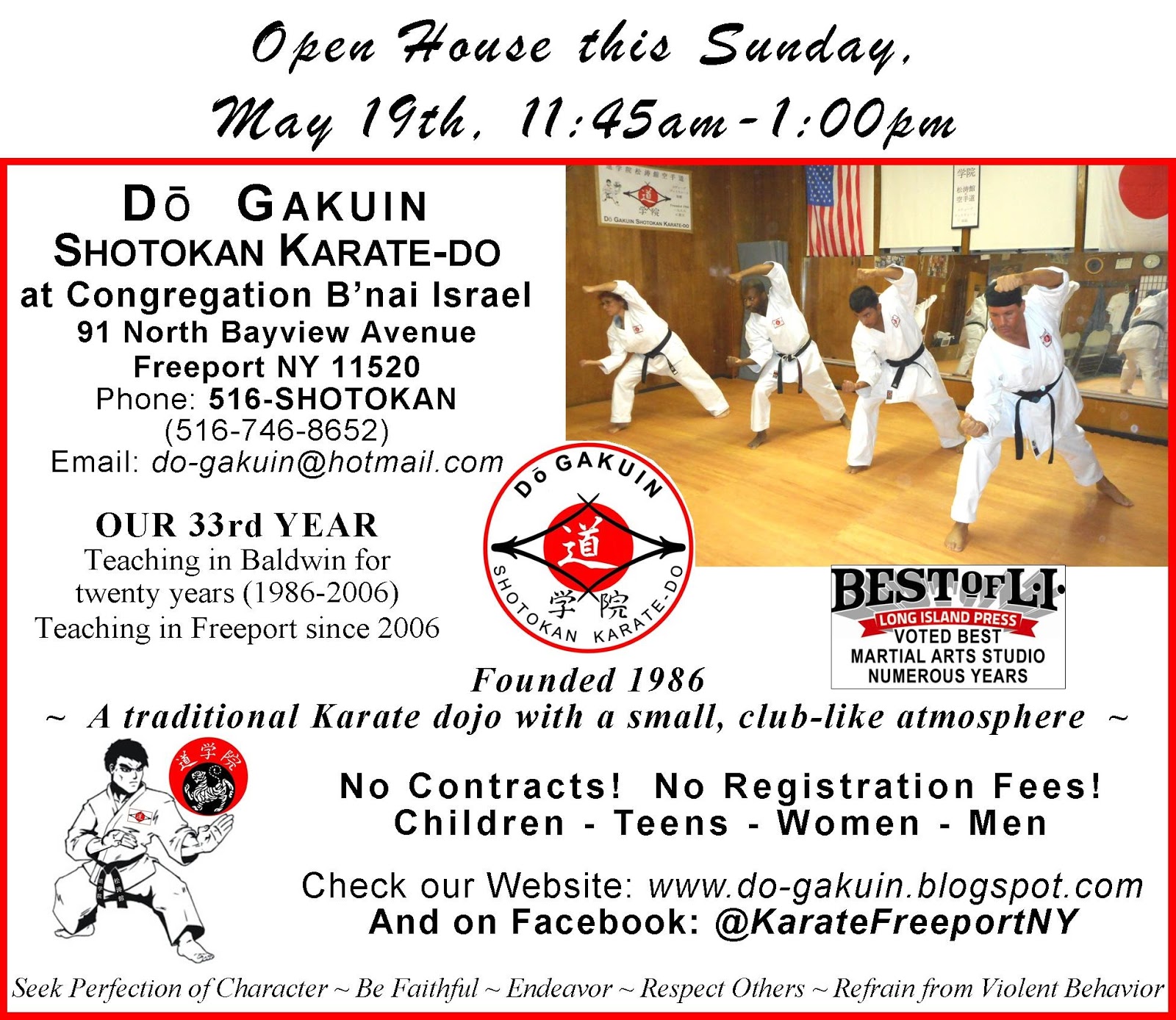
The
weekend after their dojo closed, we hosted an open house. Around 15 people showed up and took class
with us. At that time I reminded them
that the dojo almost four miles away was recommended, and their fees were
covered for six weeks. Several said
that, for varying reasons, they had no intention of going there. I said they were welcome to train here as my
guest to the end of May. They would pay
tuition as of June. This gave them a
chance to see if we are a good fit for them, and if not, go four miles where
their fees are covered for another month.
Our tuition is significantly lower than what they were paying, so a few
months with us will save more than their pre-paid June fees at the recommended
dojo. From open house to today, ten of
their members trained with us on a regular basis.
Someone
asked why all this didn’t upset me. When
the former sensei recommended that particular dojo AND NO OTHER, it was a slap
in our face - especially since the former sensei studied/trained at our dojo,
we were both members of Miyazaki OB-Kai, and we dined together several
times. He knows that we do not take
little children and the other dojo does, and likely took this into
consideration for his little tykes. He
probably made a deal with the new dojo for his students. These were sound business decisions. As it happens, the female Black Belt who
taught their little children’s classes came to our open house. She is interested in joining us and working
little children’s classes for us.
If I should be upset about
anything, it would be that the school opened in Baldwin in 2012. Baldwin was our town from 1986 to 2006, only
moving ¾ mile away to Freeport when our landlord, American Legion, sold the
building. I wasn’t upset because we rent
a small room in a Temple, no street traffic or signage, too small to mount any
major ad campaign. The sensei could say
he was unaware that he opened so close to us, same style, same Miyazaki
lineage. I remain positive. I know what we have to offer. His students will hopefully recognize it and
decide to join with us. If not, I wish
them well at the new dojo. My one hope
is that all the students continue training, improving, and bettering
themselves.
Subscribe to:
Posts (Atom)